

Vocabulary.com's Roadmap to the SAT offers systematic vocabulary instruction and a clear study plan to help students prepare for the SAT Reading Test.
Learn more about our SAT prep program!
Take the Guesswork Out of Test Prep
Students should spend their time and effort studying for the test, not figuring out how to use their test prep program. Vocabulary.com's Roadmap makes it easy to dive right in.
Students simply start with practice sessions based on our vocabulary lists. The lists are organized in three groups: Multiple-Meaning Words, Language of the Test, and Words to Capture Tone. As students practice, Vocabulary.com will automatically keep track of their individual trouble words, so their effort will be focused on the words they still need to learn, not the ones they already know. In addition to practicing these lists, students play the Challenge, an open-ended learning game that delivers personalized instruction. The Challenge is where students get the follow-up they need to master those trouble words, with questions chosen just for them.
Study Plan
| Focus Area | Week 1 | Week 2 | Week 3 | Week 4 | Week 5 | Week 6 | Week 7 | Week 8 | ||
|---|---|---|---|---|---|---|---|---|---|---|
| Multiple-Meaning Words (MMW) |
MMW: Part 1 | MMW: Part 2 | MMW: Part 3 | MMW: Part 4 | MMW: Part 5 | MMW: Part 6 | MMW: Part 7 | MMW: Part 8 | ||
| The Language of the Test (LoT) |
LoT: Part 1 |
LoT: Part 2 |
LoT: Part 3 |
LoT: Part 4 |
LoT: Part 5 |
LoT: Part 6 |
||||
| Words to Capture Tone (Tone) |
Tone: Part 1 | Tone: Part 2 | Tone: Part 3 | Tone: Part 4 | Tone: Part 5 | Tone: Part 6 | Tone: Part 7 | Tone: Part 8 | ||
| Play the Challenge (mins. x # of days) |
15 x 5 | 15 x 5 | 15 x 5 | 15 x 5 | 15 x 5 | 15 x 5 | 20 x 5 | 20 x 5 | ||
| Hours on Vocabulary.com (estimated) |
2.5 | 2.5 | 2.5 | 2.5 | 2.5 | 2.5 | 2.5 | 2.5 |
Students, here's how to get started:
Practice the weekly lists in order. Start at the top of the Week 1 column, Multiple-Meaning Words Part 1. Click the link, then click Start Practice.
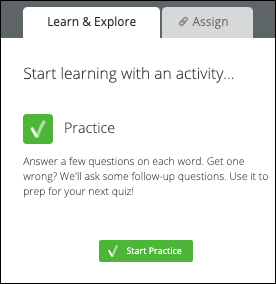
The amount of time it takes to complete practice on a list depends on how well you know the words. You can always stop a practice session and resume at another time. Once you complete the practice activity for MMW Part 1, move on to practicing LoT Part I. When you've finished practicing that, practice the Tone Part 1 list.
Aim for 3-5 practice sessions each week. We recommend that you complete the three weekly practice activities over the course of 3-5 sessions, roughly 30 minutes each. The amount of time it takes to finish practicing a list will vary depending on your understanding of the words. That's because when you answer a question incorrectly, Vocabulary.com will give you additional questions on that word to increase your exposure and teach you what it means.
Mix in Challenge play along the way. Take time between list practice sessions to play the Challenge by clicking "Learn" in the top navigation, or the Challenge card on the "Learn" page.
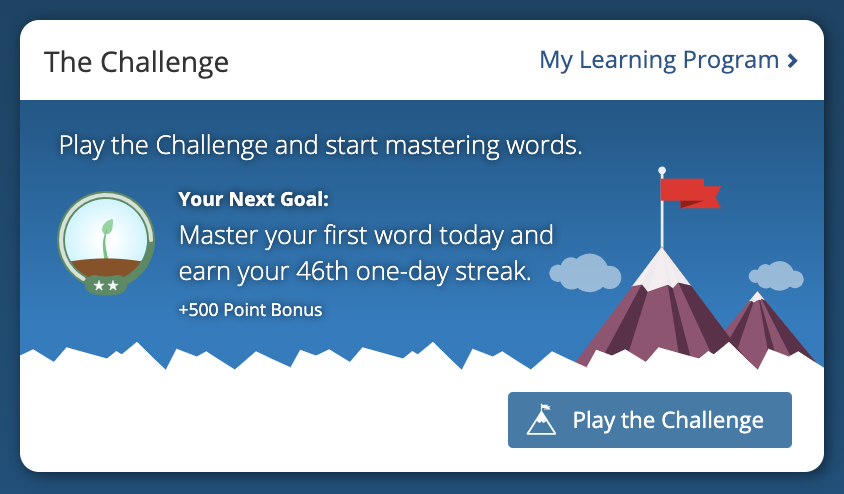
That's where you'll get the extra instruction you need to learn any of the trouble words you struggled with during practice. You don't have to finish practicing an entire list to play the Challenge — any trouble words will already be part of your personalized learning experience the next time you play.
Aim for 5 sessions of Challenge play each week. We recommend playing the Challenge for 15 minutes or more, five times a week. If you want to turbo-charge your test prep, we recommend more Challenge play. Increasing your Challenge time will increase the follow-up that you're getting on your trouble words, plus expose you to new words that we think you're ready to learn.
Repeat your routine each week. Once you complete the practice and Challenge combo for Week 1, move on to Week 2. You'll notice that the words you see in Challenge play will change over time. New trouble words from the weekly lists will be added to the mix, and you'll get the occasional brush-up question for words you've recently mastered.
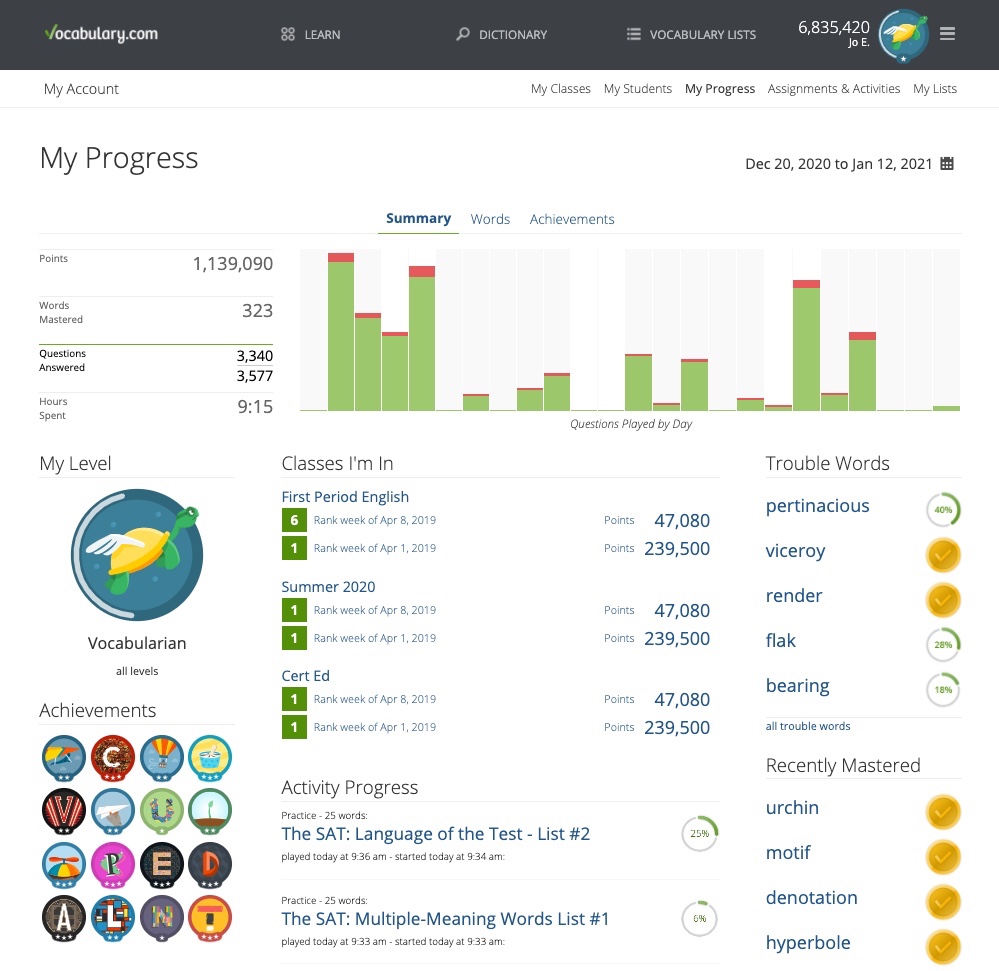
Monitor your progress. To view your recent activity and accomplishments, visit the My Progress section. The summary graph shows you how many questions you've answered, how much time you've spent, and how many words you've mastered for any time period you select. You'll see any unfinished practice activities, which words are currently giving you the most trouble, and all of the words you've mastered so far.
Additional Test Prep Resources
For students and teachers, Vocabulary.com offers many more test prep resources, including word lists and practice activities for the ACT, GRE, TOEFL and more. Visit the Test Prep section of our list library to find what you need.
For teachers, we offer free webinars to help you get the most out of our Test Prep resources. Visit the webinar calendar to register.
FAQs
Here's a more in-depth look at Vocabulary.com's Roadmap to the SAT.
Why do I need to work on my vocabulary for the SAT?
Think of the SAT Reading Test as an obstacle course, where you will be called upon to perform various reading comprehension feats. You want to be prepared to understand any of the challenging words that you encounter along the course. That's why Vocabulary.com's Roadmap to the Reading SAT teaches three types of words that are critical to understanding the language of the test and the passages themselves.
How much time should I play Vocabulary.com each week?
It varies, but you should plan to spend at least 2.5 hours each week to complete the practice assignments and mix in Challenge play. That breaks down to 5 separate 30-minute sessions, made up of 15 minutes of list practice and 15 minutes of Challenge play. Keep in mind that some lists may take more time to finish than others, and you can complete a practice activity over more than one session.
Why should I play the Challenge in addition to practicing the word lists?
Playing the Challenge will provide targeted instruction to help you learn the specific words that gave you trouble during list practice. Vocabulary.com knows what words you need to learn, so the more you play, the stronger your vocabulary will become and the more prepared you'll be for understanding the complex reading passages that will show up on the SAT.
What if I don't have eight weeks to prep for the SAT?
Don't panic! We have prioritized the most vital words up front. So, if you have only a couple of weeks to bone up on your vocabulary before taking the SAT, try to complete weeks 1 and 2 of the Roadmap. You can also invest some extra time each day to pack in as much practice as possible before the test.
Multiple-Meaning Words: Context is King
What are multiple-meaning words and why are they important to study?
Multiple-meaning words are words that have different meanings in different contexts. A multiple-meaning word like figure is used in a variety of ways, depending on the subject. You might learn about a historical figure in history class, calculate a figure in math class, or analyze a figure of speech in English class. Multiple-meaning words are especially important on the SAT Reading Test since you'll have to define them in Words in Context questions.
What are Words in Context questions like?
Words in Context questions will ask you to complete this question stem: "As used in line x, 'word' most nearly means..." Here's an example:
College Board sample question, based on the science reading passage Turtles Use the Earth's Magnetic Field as Global GPS
"In 1996, a loggerhead turtle called Adelita swam across 9,000 miles from Mexico to Japan, crossing the entire Pacific on her way. Wallace J. Nichols tracked this epic journey with a satellite tag."
As used in line 2, "tracked" most nearly means:
A) searched for.
B) traveled over.
C) followed.
D) hunted.
While all of the answer options could be synonyms for tracked, "followed" is the definition that best fits the meaning of tracked as it is used in this passage. As you can see, finding the correct answer requires you to know the word track's multiple meanings, and to pick up on the context clues that tell you the turtle's journey was followed with a satellite tag.
How will Vocabulary.com help me prepare for Words in Context questions?
As you learn the multiple meanings of words like track on Vocabulary.com, you will encounter sentence-based questions that require the same type of context clue analysis as the questions you will come across on the SAT. For example, the following is a Vocabulary.com question for the verb track:

Just like in the SAT sample question above, this Vocabulary.com question presents a sentence containing a form of the multiple-meaning word track and asks you to identify which of four synonyms best captures the meaning of the word tracking in the sentence. Because scientists are "tracking babies' gazes" in the Scientific American sentence, the only synonym that makes sense in that context is following.
Language of the Test: Learn to Speak "SAT"
What are Language of the Test words?
Language of the Test words are academic vocabulary terms that frequently show up in SAT "test talk." These are words such as infer, indicate, and characterize — words that you're likely to come across in test directions, question stems, and other parts of the test.
How will Vocabulary.com help me learn the Language of the Test?
For each word on Vocabulary.com's Language of the Test lists, we give you an explanation of how the word is likely to be used on the SAT. When you study a Language of the Test list, you're learning new words and valuable test tips at the same time.
An Example: claim
An example is the word claim, which is featured on our Language of the Test List 1 because the SAT features questions related to argumentative writing. Here is the explanatory note we include for claim:
"Claim has many meanings but if you spot it on the SAT, it will most likely refer to an argument's main point -- what the writer is trying to persuade you to believe. There could be more than one claim in an argument, but the reading passages on the SAT will most likely have one central (or main) claim that is supported by different types of evidence."
Words to Capture Tone: Getting Inside the Author's Head
What types of words capture tone?
The SAT Reading Test contains questions that ask you to figure out an author's attitude about the subject of a reading passage. Each multiple-choice question offers four answer choices, all of which are words that can be used to establish tone and point of view. To be confident that you're choosing the correct answer, it helps to understand all of the choices.
Why are words that capture that author's tone such a big deal on the SAT Reading Test?
Identifying tone is a critical part of understanding what you read. The words set the tone in a piece of writing signal the author's purpose, attitude, and perspective on a subject.
Read the following SAT Reading Test sample question, and notice any challenging vocabulary words in the answer choices.
College Board sample question, based on a literary reading passage adapted from Edith Wharton's Ethan Frome.
The author includes the descriptions of the sunset, the clouds, and the hemlock shadows (lines 77–82) primarily to:
A) suggest the peacefulness of the natural world.
B) emphasize the acuteness of two characters' sensations.
C) foreshadow the declining fortunes of two characters.
D) offer a sense of how fleeting time can be.
As you can see, this question not only requires you to determine the author's purpose, but also requires knowledge of the vocabulary terms used to describe the possible intentions and attitudes of the author. Was the author trying to emphasize or to foreshadow or to suggest or to offer? Were the character's "sensations acute"? Did the characters have "declining fortunes"? Was time "portrayed as fleeting"? If you are unsure of these words' meanings, you might find it difficult to choose the correct answer.
How will Vocabulary.com help me master words that capture tone?
By practicing the Words that Capture Tone lists, you'll be learning words in various contexts. This is a far more effective approach than memorizing definitions, because it mirrors the way you encounter words on tests and in your everyday reading. You'll learn words like acerbic and laudatory in questions using real sentences from a variety of literature and news sources. If you miss questions the first time you see them, you'll see those same questions again, plus new ones, until you get enough practice to truly master your trouble words.
Additional Test Prep Resources
For students and teachers, Vocabulary.com offers many more test prep resources, including word lists and practice activities for the ACT, GRE, TOEFL and more. Visit the Test Prep section of our list library to find what you need.
For teachers, we offer free webinars to help you get the most out of our Test Prep resources. Visit the webinar calendar to register.

