Dept. of Word Lists
Ode to the Language of the Declaration
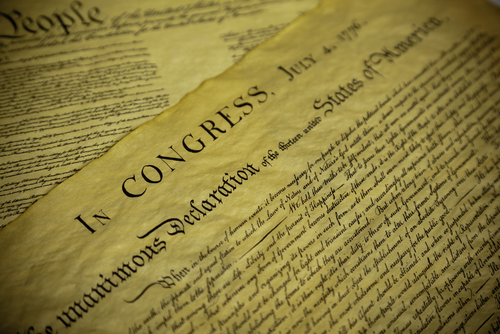
If Thomas Jefferson's Declaration of Independence were a song, it would be a classic "you've done me wrong so I'm leaving you" kind of song, with verse after verse of detailed bad behavior by the King of England. The Declaration contains some powerful accusations, but they are often expressed in words we don't use today. Here I'll examine some of the most powerful word choices.
Perfidy
...circumstances of Cruelty & perfidy scarcely paralleled in the most barbarous ages, and totally unworthy of the Head of a civilized nation.
If there is one word that sums up what the authors of the Declaration are accusing the King of, perfidy might be it. It means "betrayal of trust," with an added sense of falsehood and treachery. At one time, the King was above his subjects because that king was held to be chosen by God, and because of this, by definition, the King had to know what was best for the people he ruled. The idea that what bonds a king to his subjects is trust and that this trust could be broken or betrayed had never been given as a reason for declaration of revolution before.
Usurpation
But when a long train of abuses and usurpations...evinces a design to reduce them under absolute Despotism, it is their right, it is their duty, to throw off such Government, and to provide new Guards for their future security.
Usurpation is used in the Declaration to describe the King seizing more power for himself in order to basically become a despot, or one who holds absolute power and is cruel when using it. Usurpation is about overstepping boundaries and wrongfully holding what isn't yours. The Declaration uses the word in a very interesting way because most of the time it is people in power who are usurped, by enemies who want their throne, for example. In the Declaration, it is the King who is doing the usurping by taking power and rights that belong to the people. By assigning the common people rights, and by calling any infringement on those rights a usurpation, Thomas Jefferson has subtly made the King and his subjects all but equal.
Rectitude
We, therefore, the Representatives of the United States of America… appealing to the Supreme Judge of the world for the rectitude of our intentions, do… solemnly publish and declare, That these United Colonies are, and of Right ought to be Free and Independent States.
The Declaration of Independence doesn't only consist of complaints about how the King of England is treating the colonies; it also draws a line connecting these instances of poor treatment to the actions that the colonists are prepared to take in order to correct them. The document seeks to justify its conclusions, and here's where a word like rectitude can be so powerful. Rectitude is righteousness, specifically as a consequence of being honorable and honest. In addition to drawing a contrast between their purpose and the dishonest behavior of King George, the use of a word like rectitude also assures the reader or listener that the men who stand behind this document have no agenda other than their stated reasons. Jefferson and his fellow members of the Continental Congress are confident that their cause is just, and they have appealed to an authority higher than the King, "The Supreme Judge of the World," to make sure of it.
UnalienableWe hold these truths to be self-evident, that all men are created equal, that they are endowed by their Creator with certain unalienable Rights, that among these are Life, Liberty, and the pursuit of Happiness.
At the core of the Declaration's uses of several of these words is its concept of the common people. A King chosen by God or other supreme authority can argue that he doesn't have to follow the laws made by men. But if the people themselves are "endowed by their Creator" with rights that are unalienable, rights which are not to be taken away or infringed upon, then the King has an area that even he cannot tread upon. If this idea is joined with the notion, also from the Declaration, that Governments are institutions "deriving their just power from the consent of the governed", then the King's relationship to the people has been completely changed by two definitions. The concept of unalienable rights did not come from the Declaration of Independence, but it may be most powerfully used here.
Although it also commemorates the war that followed, The Fourth of July is a holiday about a piece of parchment and the persuasive case for revolution made on it. With careful word choice and instance after instance of abuse by their King, Thomas Jefferson and the other members of the Continental Congress declared to the world that it was time for independence.