Wordshop
Vocab activities for your classroom
Staring, Glancing and Glaring Through Stephenie Meyer's "Twilight"
Despite its popularity among teens, you're not going to find class sets of Stephenie Meyer's Twilight series in the English department book rooms across the country. Most English teachers don't regard it as "true literature" and are not crafting curricula around the genre of vampire romance novels. However, even if most teachers don't incorporate trendy literature into their class syllabus, it doesn't mean that they can't take advantage of the excitement of the fad and harness it to teach some valuable lessons about writing, editing, and word choice.
If you search the Internet, you'll soon discover that many readers are quite passionate about Stephenie Meyer's use of particular words. This post on Yahoo! Answers complains about her overuse of certain words like grimace and chagrin :
Wow... I just read the first twilight book and her half draft of it in Edwards point of view. and I've noticed something. she has a very low vocabulary... i mean... i'm sure she could have busted out a thesaurus to look up another word for grimace or chagrin. I love the book so far and all but I mean... if she's graduated from university with a degree in english literature, shouldn't she have a larger vocabulary. i'm not complaining that, yes, it's easy to read... but it's a bit excessive... actually very excessive with how much she uses words over and over... and over!!! I loved the book.. but it was just something i noticed... and i was also wondering could anyone give me some more examples of words she overuses?
While the previous commenter thinks that Meyer "could have busted out a thesaurus" to solve her word choice woes, this commenter complains that busting out the thesaurus was actually Meyer's downfall:
Defining Thesaurus Abuse
The controversy raised in these two posts about what is responsible for Meyer's poor word choice can provide a golden opportunity for you to introduce the topic of "thesaurus abuse" in your classroom. Let your students decide for themselves whether or not Meyer is guilty of neglecting the thesaurus or overusing it.
Thesaurus abuse (or "synonym-itis" as writer James Harbeck likes to call it in this article) is the unfortunate tendency for some writers to overuse the thesaurus in an effort to spice up their word choice. Of course, as teachers, we want to encourage developing writers to use the thesaurus, but we don't want them to use word variety for variety's sake alone. Thesaurus abuse can result in the use of words that sound awkward and can be distracting to the reader. As the second commenter points out, since Meyer's narrator is a sixteen-year-old girl, she should use words that sound natural coming from that point of view. Explain to students that just like they wouldn't want to show up to a coffee shop wearing a cocktail dress or a tuxedo, they also wouldn't want to use words that sound out of place or too attention-seeking in their own writing.
VocabGrabbing Twilight
VocabGrabber is a great tool to help students compare and contrast a writer's use (and abuse) of particular words.
When I VocabGrabbed the text of Twilight, filtered it to show only "Vocabulary" words, and sorted by "Occurences" to see which vocabulary words Meyer used most often, I was struck by how often she used these different words for different ways of looking:
| WORD | Occurrences in Twilight |
| stare | 181 |
| glance | 94 |
| glare | 43 |
| gaze | 36 |
| glower | 4 |
Whether of not Meyer used a thesaurus to generate multiple alternatives for the verb "to look" is debatable, but having your students examine the shades of meaning between all the related verb choices is a worthwhile exercise. If we look at the Visual Thesaurus semantic map for words related to the meanings "to direct one's gaze towards" or "to fixate one's eyes," students can experiment with substituting some of those words for the words Meyer used repeatedly.
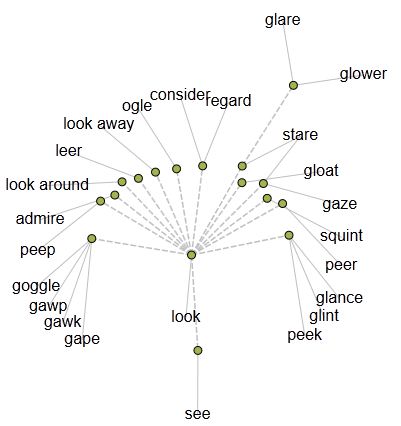
Such a discussion on word choice can lead in many directions. Which of these words sounds natural for a 16-year old narrator to use? Which do not? Could Meyer have used more variety or less? For those students who are familiar with the Twilight novels or movies, which of these words would apply to Edward? To Bella? In which scenes?
Empower Students to Edit Meyer
Another verb Meyer seems overly attached to in Twilight is chuckle (appearing 38 times throughout the novel). Have students look at the following example sentences from the text and decide whether or not chuckle is the best verb choice for each one.
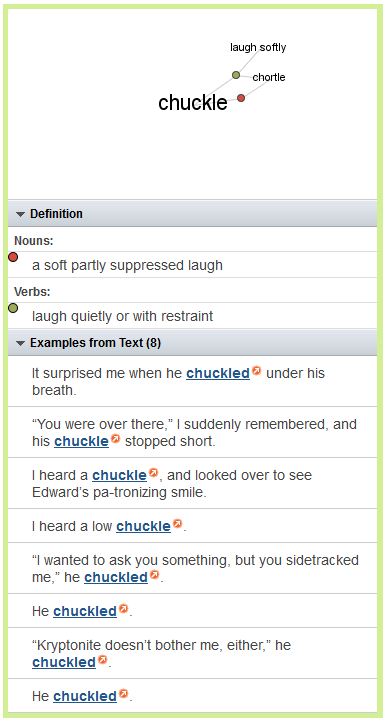
After reading Meyer's use of chuckle in the novel, you can ask students to consider all the different ways Meyer's characters could laugh. Students could even demonstrate chuckling, snickering, tittering, etc. as they weigh the choices. Once they are familiar with their options, ask them to edit one of Meyer's sentences by substituting another verb for an awkward use of chuckle (while reminding students that the more common laugh is always an option).
The Takeaway:
Students will notice that Edward is frequently the character Meyer portrays as glaring and chuckling his way throughout Twilight. How does this repetition of verbs influence your students' perceptions of Edward as a character? Does it make Edward seem more like a cartoon character or a real character? How could they edit Meyer's descriptions to make Edward seem more real?
An important message from this lesson on Meyer and word choice is that even a best-selling author can use a good editor. And your students, who may not often view themselves as capable editors, should feel empowered by this notion. They know what sixteen year old girls sound like, and they can offer that perspective as editors for Twilight. And, by experimenting with word choice options, they will become more aware of when it's appropriate to "bust out the thesaurus" and when it's best left on the shelf.
(Click here for 150 vocabulary words from Twilight.)