|
|
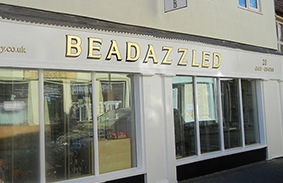 Beadazzled
 is the name of a shop in a small town in the UK. A church in a city in Australia encourages passersby to "Prevent Truth Decay – Brush up on you Bible." These signs create something linguists Rodrigue Landry and Richard Y. Bourhis defined as "the linguistic landscape of a given territory, region or urban agglomeration" and they are all useful tools in the teaching of English to non-native speakers.
Continue reading...
In my last column, I asked several multi-published authors this question: What advice do you wish your English teacher would have given you? Now, in this column, I'm going to share the answers to the second question I asked: What was the most important thing you learned in your English class that had a lasting impact?
Continue reading...
Lately, I've been talking about Stephen King while teaching Edgar Allan Poe. When King was in middle school, he wrote a "novel version" of Poe's "The Pit and the Pendulum," based on the horror-movie adaptation. When his teacher, Miss Hisler, caught him selling mimeographed copies, she asked him why he was writing such "junk."
Continue reading...
Teachers, let's be honest. Most kids these days are more interested in the watching the latest video, writing a text, checking their social media or sending a Snapchat than they are digging into Mark Twain's Huck Finn (there's a movie for that).
Continue reading...
Once, a long time ago, my English III class began whining when I assigned an essay. "Why does it have to be five paragraphs? Why do we have to write this?" Without addressing the latter question, I answered very easily, "Let's make it ten."
Continue reading...
One of the students in my Fiction Writing Workshop told a classmate to take a red pen and cross out the multitude of adverbs he had strewn throughout his story. The rest of the class nodded their heads in agreement. But just before I could move us on to the next item on the agenda, the author asked the young woman who'd spoken up, "But why? Why can't I use adverbs?"
Continue reading...
To encourage summer reading, the school librarians went around to the English classes and talked up reading. For the first hour, they pushed around a cart filled with popular books, including current favorites Divergent and The Fault in Our Stars. They checked out a total of three books.
Continue reading...
|
Other Departments:
|




